
Media Once Saw Abbott as Untouchable. Now They’re Calling the Texas Governor’s Race Competitive.
Texas is becoming predominantly Hispanic, as Latinos there have outnumbered Whites since 2023. Current Census QuickFacts estimates show Hispanics or Latinos comprise 40.9% of the state’s population, while White, non-Hispanic people are at 37.3%.
Given this demographic shift, is Texas ready to elect a Hispanic Governor?
A candidate who could potentially make history as the first Hispanic governor of Texas and the first Democratic elected governor of Texas in decades is Democratic State Representative Gina Hinojosa. She is challenging popular incumbent Governor Greg Abbott in the upcoming midterm elections.
“Absent Abbott is scared to debate me because he’s a weak governor who’s afraid to face his failed record.” – Gina Hinojosa
Although Hinojosa is mounting a competitive campaign, current polling data indicates she’s facing an uphill battle. Recent polls continue to indicate that Abbott maintains a lead.
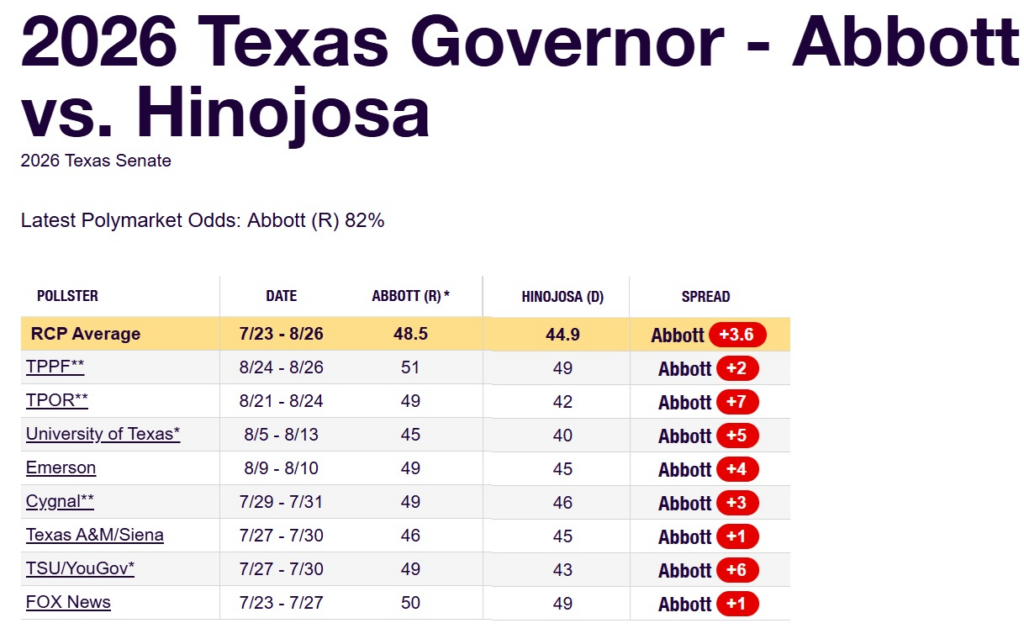
Nevertheless, the race is attracting interest because several summer polls show relatively small margins. For example, a July survey conducted by the Bush School/ReconMR indicated that Abbott was leading by just 1 percent. Similarly, a poll conducted by Fox News also showed both candidates were separated by just one percentage point. However, more recent polling has indicated wider gaps. Specifically, Emerson College found that Abbott led Hinojosa by four percent, while the University of Texas/Texas Politics Project survey indicated that Abbott maintained a five percent advantage.
An N+ Univision poll released on Sept. 9 showed both candidates tied at 47% with 5% undecided.
Republicans have controlled every statewide office in Texas since 1995. In addition, the outspoken Abbott is widely regarded as a Republican favorite, having won three previous gubernatorial contests.
Controversial Facts about Gov. Gregg Abbott
1. Abbott signed what may be the country’s most draconian anti-abortion law. Texas’ Human Life Protection Act generally bans abortions — except if a doctor believes a woman is so physically ill from pregnancy that she could die or suffer serious health problems. The Texas Supreme Court upheld the law in 2024. Proponents say this law protects the lives of unborn babies. Opponents claim this law limits access to medical treatment and does not allow women enough freedom in making their own decisions. Secondly, are doctors refusing to perform abortions even when a woman’s life is at-stake for fear they’ll come under attack for for doing the procedure?
2. In 2024, he issued a full pardon to Daniel Perry. Perry had been convicted of murdering Garrett Foster after killing him during a racial justice protest in Austin on July 25, 2020. Perry, who was serving in the Army at the time, shot Foster after Foster walked toward him holding a sign. After being found guilty by a jury of his peers, the Texas Board of Pardon and Parole voted unanimously in favor of issuing Perry a full pardon.
Abbott said that because Perry used Texas’ self defense laws (in which a person can use deadly force against another if they reasonably believe such deadly force is necessary to prevent imminent death or serious bodily injury) to defend himself, Perry should receive a pardon. However, the decision was met with outrage and anger as many felt that by granting Perry a pardon, the consequences of the jury’s verdict were essentially negated.
3. Abbott also put up floating barriers along the Rio Grande. One component of Abbott’s efforts to enforce the borders of Texas involved placing approximately 1000 linear feet of very large buoys along the river where it forms much of the border with Mexico, specifically near Eagle Pass. The United States Department of Justice filed suit against Texas claiming that Texas did not obtain legally required permission from the federal government to place the buoys along the river and claiming the buoys raise humanitarian, navigation and diplomatic issues. Prior to finalizing the lawsuit, a U.S. District Judge initially ordered Texas to remove the buoys until further action was taken regarding litigation.
4. Texas paid tens of millions of dollars to help expand an artificial intelligence (AI)-powered surveillance system based on automobile license plates — but then Abbott took steps to stop funding for the project. Since at least 2023, a state agency in Texas has provided at least $30 million in grant money to assist cities and counties in installing at least 3200 Flock cameras (a type of surveillance camera). Many members of the agency’s governing body are appointed by Abbott. Following reports of police abuse and bipartisan concern regarding citizens’ right to privacy, in August 2026, Governor Abbott ordered all state agencies to cease providing funds for the cameras.
5. Abbott implemented school voucher programs in Texas — however, subsequent data suggests how few students actually benefited from them. According to new data released in 2026, at least 70 percent of students who participated in the program were either currently attending private schools or being home schooled prior to receiving vouchers. The Abbott Administration claims that expanding parents’ options for choosing the educational experience they deem best for their child is why the program exists; others criticize it as an expensive way to fund private education.